No, Donald Trump Didn’t Call Nazis “Very Fine People”
Written by David E. Smith
More than nine years after the violent Unite the Right rally in Charlottesville, Virginia, Fox News commentator Jessica Tarlov finally listened to the audio of President Donald Trump’s “very fine people” remarks. What she heard should have been obvious to anyone who read the transcript back in 2017.
On the November 21st episode of “The Focus Group” podcast, Tarlov admitted that she hadn’t previously listened to the audio and found that “a little embarrassing.” Once she listened, she understood Trump to be talking about the dispute over removing Confederate statues. She called that realization “illuminating.” Watch this short segment:
Imagine that. Listening to what someone actually said can change what you think they meant.
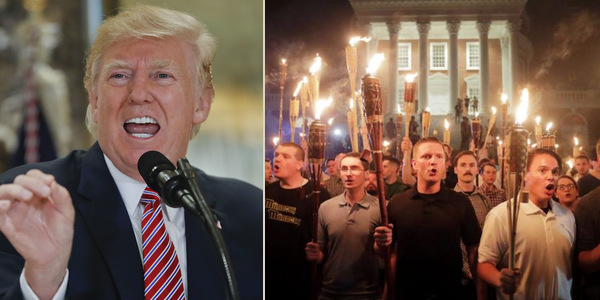
At his August 15, 2017, press conference, Trump said there were “very fine people on both sides.” He also explained whom he meant. He pointed to people who had come to oppose the removal of a statue of Robert E. Lee, and he explicitly excluded the neo-Nazis and white nationalists, saying they “should be condemned totally.” In June 2024, even Snopes rated the claim that Trump called neo-Nazis “very fine people” false.
Joe Biden put Charlottesville front and center when he launched his 2020 presidential campaign. He quoted the “very fine people” line and accused Trump of drawing a moral equivalence between those spreading hate and those who stood against it. Trump’s explicit condemnation was already on the record. How many voters heard Biden’s version and never heard that part?
And that’s what should bother us about the drive-by media. A quote taken out of context gets repeated for years, and we’re told it’s proof positive that Trump is a racist. Then a national commentator finally listens to the audio and hears Trump explicitly condemn the very people he was accused of praising.
This is why conservatives must be diligent about calling out deceptive spin — often deliberate — and refuting false claims whenever and wherever we can. In this case, the transcript was there all along.
Tags: confederate statues, Donald J. Trump, Jessica Tarlov, Joe Biden, Robert E. Lee, The Focus Group
 Federal Elections, Political | David E. Smith |
 November 23, 2026 7:00 AM