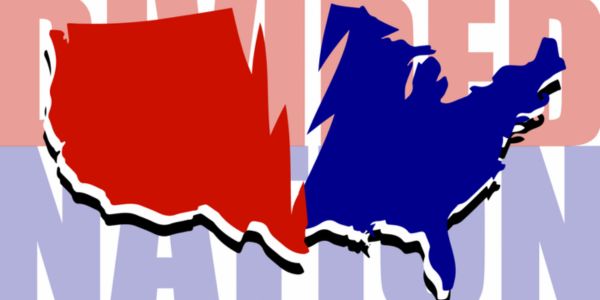
A Nation Divided
Written by Thomas Hampson
We live in a divided nation. The unity we built 250 years ago is now fractured, and our disagreements have become so intense and sometimes so violent that they threaten the very fabric of our civil society.
One of the most volatile flashpoints today is the disagreement over how we enforce our national immigration laws.
Today, across the nation, hundreds of local “sanctuary” jurisdictions openly defy federal authority. We have seen this before.
In 1858, Abraham Lincoln spoke about a similar division he observed. During his campaign for the United States Senate, he emphasized the urgent need to mend the rifts dividing the nation. On June 16, 1858, while addressing the Republican State Convention at the Illinois State House, Lincoln delivered the words that would define the century:
“A house divided against itself cannot stand.”
He used this ancient biblical principle to remind the gathered legislators that no family, no community, no nation can survive while working at cross purposes with one another. Diversity is not our strength.
Our strength is in unity.
This “legal diversity”—the idea that a federal mandate can be ignored in San Francisco but enforced in San Antonio—is the very definition of a house divided. It marks a return to a dangerous era of nullification, in which local politicians act as if they were sovereign over the nation itself.
In the mid-19th century, Northern states passed “Personal Liberty Laws” to block federal marshals; today, sanctuary jurisdictions use similar tactics to obstruct ICE. The players have changed, the principle has been distorted—conflating runaway slaves with those who enter this country illegally—but the defiance of federal law remains the same.
Proponents of these policies often shield them with the language of compassion, but they overlook a core truth of governance: A government acts as a fiduciary, not a charity. A nation is a contract between its citizens and their elected leaders, funded by the labor and taxes of those who follow its rules. When a city official chooses to use local resources to protect those who have bypassed our legal process, they are not just practicing ‘inclusion’—they are breaking a contract with their own tax-paying citizens and legal residents.
The fiscal toll of this division is staggering.
According to 2024 data from the Federation for American Immigration Reform (FAIR), the net burden of illegal immigration on U.S. taxpayers has soared to over $150 billion annually. Some have challenged the figures claimed by FAIR, but given that we have limited resources, every dollar spent on “sanctuary” is a dollar taken from the schools, emergency rooms, roads, police, military, airports, air traffic controllers, and other vital parts of society, promised to the legal citizens who built this nation.
We cannot maintain these complex systems where residents are forced to pay for the upkeep of those who entered illegally and take advantage of our generosity.
The consequences of this are reflected in the lives of innocent citizens. Recently, members of the Illinois House and Senate united to raise awareness about what they called a complete breakdown of public safety caused by the state’s radical sanctuary policies. State Representative John Cabello and Senator Jason Plummer both highlighted a disturbing timeline of preventable tragedies—most notably the senseless murder of 18-year-old college student Sheridan Gorman on Chicago’s lakefront.
These legislators pointed out the “common-sense” failure of the current system: the person allegedly responsible for Sheridan’s death was caught at the border in 2023, released into the U.S., arrested again in Chicago within 30 days for retail theft, and then released again despite not showing up for court. For two years, an active warrant existed for a man who remained free, allowing him to commit the ultimate crime. As Senator Terry Bryant observed, even when ICE issues a detainer, Illinois’ “Trust Act” and “Way Forward Act” make those requests effectively meaningless, legally preventing local police from cooperating with federal warnings.
The message from the Republican leadership of the General Assembly is a clear call to action:
“Have you had enough yet?”
They are now demanding the immediate repeal of these laws through measures such as House Bill 1317 and Senate Bill 1316, which would restore local law enforcement’s ability to coordinate with federal officers.
The legislators stressed that this violates the government’s core duty. While Governor J.B. Pritzker and Mayor Brandon Johnson continue to focus on what Representative Cabello called “failed sanctuary state policies” and “anti-police rhetoric,” billions of taxpayer dollars are being directed toward healthcare and benefits for over 550,000 illegal immigrants, even as legal residents endure the “mayhem and madness” in their neighborhoods.
These figures are supported by the Pew Research Center’s 2025 analysis of unauthorized immigrant populations by state, the Illinois Department of Healthcare and Family Services (HFS) analysis, and independent audits by the Illinois Policy Institute.
As the Gorman family stated in a heartbreaking address read by Senator Bryant:
“When systems fail… the consequences are not abstract. They are real and… permanent.”
By refusing to allow state and local law enforcement to cooperate with federal authorities, the current administration has turned Illinois into a house divided against itself—a place where the government has abandoned its fiduciary duty to its own people in favor of an ideology that provides sanctuary to criminals while leaving its citizens to mourn.
Those on the other side of this issue seem to have four basic points of opposition to our existing immigration laws:
- Where we see a Citizen, they see a Person. Proponents of this view believe that human rights are “de-territorialized”—meaning they are inherent to your existence as a human, not granted by a government or a passport. In their view, a border is a mere “accident of birth.” To them, denying a person the right to work or seek safety based on where they were born is as morally arbitrary as denying rights based on race or gender. They do not see themselves as “pro-illegal immigration,” but rather “pro-freedom of movement” (ius migrandi).
- Where we see the Rule of Law, they see a Broken System. Supporters believe the current U.S. immigration system is “draconian” and “unjust.” They interpret local non-cooperation not as lawlessness, but as a form of “civil disobedience” against a federal regime they view as violating fundamental human dignity. Their ultimate goal is to protect families from separation, considering federal enforcement—such as ICE raids—as a breach of a “higher moral law” that requires the protection of the vulnerable.
- Where we see Non-Cooperation, they see Public Health and Safety. This is their most pragmatic pillar. They argue that when local police act as “deportation agents,” immigrant communities are forced underground. This results in a “shadow population” that stops reporting crimes, stops seeking medical care for infectious diseases like TB, and stops acting as witnesses in criminal trials. They believe a city is objectively safer when 100% of the population trusts the police, ensuring that no one is too afraid of ICE to report a local murderer or rapist.
- Where we see Nullification, they see States’ Rights. Ironically, they use the same Tenth Amendment that conservatives have historically championed. They argue that the federal government cannot “commandeer” local police to enforce a federal regulatory program. Their goal is to keep a clear line between local and federal power, asserting that if the federal government wants to enforce immigration law, it should provide the funding and personnel to do so itself, rather than “stealing” local tax dollars to meet federal mandates.
The core of the divide is this: two sides speak two different languages of morality and law. One side emphasizes the National Contract—the obligation of a government to its own citizens first. The other emphasizes a Universal Moral Claim—the obligation of a community to all human beings regardless of status. Until we close this gap, our “house” remains unstable—divided between those who honor the U.S. Constitution and those who have cast it aside in pursuit of a new world order.
Everyone should understand that the impasse we face is not just a policy disagreement; it is a fundamental crisis. We are trying to maintain a structure currently occupied by people who hold two incompatible ideas: one that regards the nation as a sovereign home with a duty to its own citizens, and another that sees it as an open territory with a duty to the world.
However, as Abraham Lincoln warned nearly 170 years ago, it must become entirely one thing or the other.
To resolve this deadlock without descending into the chaos of our past, we must return to the “common-sense” understanding that the government is a fiduciary, not a charity. While individuals may show a “universal” compassion in their private lives, a nation-state exists to safeguard the specific legal and physical security of the people who entered into its social contract.
When local officials elevate their personal “higher law” above the federal statutes they are obligated to uphold, they aren’t just practicing inclusion—they are undermining the very idea of American citizenship.
The evidence of this decay is no longer an abstraction. It is found in the $150 billion annual bill handed to taxpayers. It is found in the thousands of criminal offenders released back into our neighborhoods by ideologically driven ordinances. Most tragically, it is found in the empty chairs at the dinner tables of families like the Gormans and the Abrahams in Illinois.
According to ICE documentation, in Illinois in 2025, 1,768 illegal aliens with detainers were released back into the community. The majority of these cases occurred in Cook County. According to recent testimony by Homeland Security Secretary Kristi Noem before the House Judiciary Committee, sanctuary jurisdictions nationwide declined to honor 17,864 ICE detainers during the 2025 calendar year.
If we truly want to heal the rift, we must demand a return to a single, unified Rule of Law. We cannot have “sanctuaries” from the law in a land that claims to be governed by the law. We must repeal obstructions like the Illinois Trust Act and embrace the clarity of the End Sanctuary Cities Act. We must insist that our strength lies not in the “diversity” of our legal standards, but in the unity of our national sovereignty.
Lincoln did not expect the house to fall, but he knew it could not remain divided. Today, we are in the same position. And we can do something about it.
We can choose to be a nation of laws, or we can choose to be a collection of competing jurisdictions—but we cannot be both. For the house to stand, the border must exist, the law must be supreme, and the sanctuary of the American citizen must once again be our first priority.

Tags: Abraham Lincoln, FAIR, Federation for American Immigration Reform, Governor J.B. Pritzker, ICE, Illinois Department of Healthcare and Family Services, Illinois Policy Institute, Jason Plummer, John Cabello, Kristi Noem, Mayor Brandon Johnson, Pew Research Center, Sheridan Gorman, Terry Bryant, TRUST Act, Way Forward Act
 Illinois Politics, Political | Alyssa Sonnenburg |
  March 28, 2026 6:00 AM