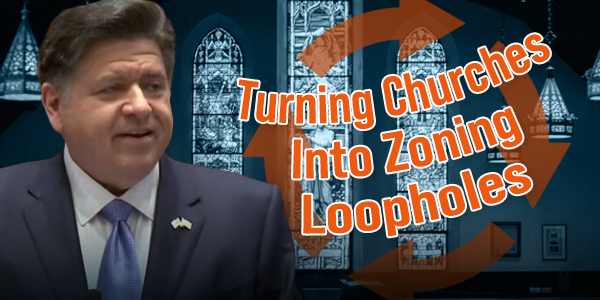
Turning Churches Into Zoning Loopholes
Written by David Curtin
Governor JB Pritzker is currently “tackling” the housing shortage in Illinois by proposing the BUILD Act. It is basically a state takeover of local housing regulations in order to do what “the state thinks best.”
The Senate Democrats have problems with this proposal – it didn’t go far enough. Sigh. They introduced a package of proposals that made the BUILD Act seem sunny by comparison. All well-meaning, mind you, but seriously doubling down on the state overriding local housing regulations.
One of these Senate bills sounds good on paper. The devil is in the details. Senate Bill 635 specifically targets property owned or controlled by churches and other religious organizations.
Supporters have even given the idea an appealing name: “Yes in God’s Backyard.”
Under SB 635, an established church or other faith-based organization could allow multifamily housing, supportive housing, group homes or mixed residential-commercial developments to be built on its property “by right.”
That phrase is important. It means the project would not need local zoning approval. What could go wrong?
Well, for one, the legislation would permit buildings as tall as six stories, and locally elected city council members would all be in straitjackets. They could not require any public hearings or discretionary design reviews. They certainly could not require special-use permits or planned-unit-development approval.
But that’s not all. A project containing five or more units would have to reserve at least 20% of its rental units for low-income or very low-income households. This would be a mandate. State mandates are not usually what real estate markets like to see. But let’s set aside the “state mandate” problem.
What’s wrong with the church offering part of its property for low-income or very low-income housing? Nothing. They can do that now if they would like to. However, here’s the rub: SB 635 would mandate that the church does this if it is going to build five or more units on church property. That, my friends, is another way of saying, “Strings attached.”
You know all of the state’s laws that say it’s discrimination to say a boy can’t become a girl, that two men or two women are “married,” that specifically hide abortions of teen girls by their sex traffickers who bring them to Illinois? These laws go against every major religious denomination’s tenets and morals. The state would be able to enforce these laws upon churches in the name of “housing fairness.”
Supporters portray this as empowering churches. But it’s a way for developers to hopscotch over local zoning ordinances by using church property to build. And private developers have a much different mission than church members.
But don’t worry. Our state politicians know what’s best. In fact, the church would not even have to construct or operate the housing. The bill expressly allows a private development partner to do so under an agreement with the religious organization. To make matters worse, the special zoning waivers would apply whether or not the church continued operating a sanctuary, school or ministry on the property.
So here’s how that would go…. Developers could approach churches—particularly smaller congregations facing declining attendance or financial pressure—with promises of new revenue. A congregation might sign a long-term agreement without fully understanding the financial, legal and spiritual consequences (there are no local review guardrails, after all).
Once the project moves forward, church property could be transformed into a large commercial housing project largely beyond the control of church members and their surrounding community. Whose morality prevails? The state’s immoral views must prevail by law. Churches just signed over their rights.
There are tax consequences as well. Churches would give up their religious-use property-tax exemptions. It might qualify for a charitable exemption, but only when used exclusively for charitable purposes and not leased or operated for profit. A church entering an agreement with a private developer could therefore find part of its property placed on the tax rolls.
Now churches have provided housing and charitable assistance for centuries. When a congregation prayerfully decides that housing advances its mission, government should not place unreasonable obstacles in its way.
As of now, SB 635 has not become law. It passed the Senate Executive Committee but was returned to the Senate Assignments Committee at the end of May. Next year it will be introduced with a new bill number, but it is expected to be the same bad language and idea.
Church property exists to serve the worship and mission of the church. It should not become a loophole for imposing statewide housing policy on local communities.
This is why elections matter. When Christians stay home, candidates who favor greater state control gain power, leaving communities with less say over decisions that affect their churches and neighborhoods. Vote on November 3rd, and encourage others to do the same.
Pastors and church leaders, remind your congregations that their votes matter. Encourage them to vote in keeping with their Christian convictions.

Tags: BUILD Act, Gov. JB Pritzker, Gov. Pritzker
 Illinois Politics, Religious Liberty | Alyssa Sonnenburg |
  September 28, 2026 5:00 AM