Quinn Pushes Millionaire Tax as “Relief” for High Property Tax Burden
Written by David E. Smith
Former Illinois Governor Pat Quinn recently held a press conference at the State Capitol to push for property tax relief. And he’s right about one thing: Illinois property taxes are crushing families. According to the Illinois Policy Institute, our state has the second highest property tax in the nation. And yes, we agree that relief is needed.
But instead of addressing the root problem—out-of-control government spending—Quinn is proposing yet another tax.
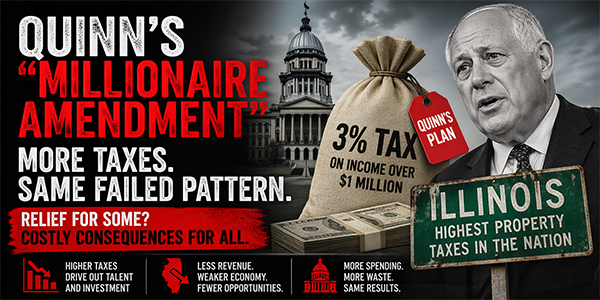
His plan, dubbed the “Millionaire Amendment,” would place a binding constitutional amendment on the November 2026 ballot. It would impose a 3% surcharge on income over $1 million—something Quinn claims would generate $4.5 billion annually. That revenue would be funneled into a state property tax relief fund, providing rebates to homeowners and businesses while also supporting public education.
It is important to note that a binding constitutional amendment to implement a progressive income tax was defeated in 2020, with only 46.8 percent voting in favor. That proposal would have replaced Illinois’ flat tax with graduated rates but was not tied specifically to property tax relief.
In 1985, Illinois lawmakers directed state lottery proceeds into the Common School Fund to support K–12 education. Today, the lottery contributes more than $750 million annually. It was supposed to supplement education funding—but lawmakers routinely use lottery dollars to replace, not increase, general education spending—freeing up tax revenue for other priorities instead of funding government schools.
FYI – The state’s overall education budget totals approximately $11.1 billion for approximately 1.86 million students. That equates to approximately $5,968 per student.
The Narrative
If you simply listen to the proponents and the liberal media, it certainly sounds like relief. But in reality, it’s redistribution. It is robbing Peter to pay Paul. It is essentially theft.
Quinn and his Democratic allies, including State Representatives La Shawn Ford (D-Chicago) and Natalie Manley (D-Romeoville), argue that Illinois’ flat tax system unfairly burdens middle-income families while allowing high earners to pay less. But their definition of “fairness” continues to ignore the real problem: waste, fraud, and bloated government spending.
Raising taxes on the most productive citizens isn’t reform—it’s punishing success instead of fixing the problem.
And it raises a serious question: What happens when those high-earning taxpayers leave Illinois?
Illinois has already seen a steady outflow of residents. When high earners relocate to states like Texas, Florida, Tennessee or Nevada with no state income tax—they don’t just take their tax dollars with them. They take investment, jobs, and economic activity. Wealthier residents tend to support local businesses, invest in property, and create employment opportunities. Their departure weakens the very economic foundation the state depends on.
Yes, a tax like this may produce a short-term bump in revenue. But over time, it accelerates the very decline that undermines the state’s economic well-being.
This is the same failed pattern: tax more, spend more, and ignore the consequences—along with turning a blind eye to the increasing waste and bloat.
If lawmakers are serious about property tax relief, they must confront the real driver: reckless and irresponsible spending—not dream up new ways to squeeze more “revenue” from taxpayers.
To appear on the ballot, the amendment must receive a three-fifths majority in both legislative chambers by May 3, 2026. Quinn points to 60 percent voter support for a similar advisory question in 2024 as evidence of momentum. Still, critics—including Republican candidates—warn that this approach is not a solution, but a risky gamble that could further erode Illinois’ economic base.
The bottom line: Why should taxpayers trust Springfield politicians to deliver relief when their track record shows they’ll just waste the money?
This article was composed and finalized by the author.
IFA staff and AI tools were used for proofing and clarity.

Tags: Common School Fund, Illinois Lottery, Illinois Policy Institute, La Shawn Ford, Millionaire Amendment, Natalie Manley, Pat Quinn, property tax relief
 Illinois Politics | David E. Smith |
  April 21, 2026 9:00 AM