A Free Press or A Government Subsidized Press?
Written by David E. Smith
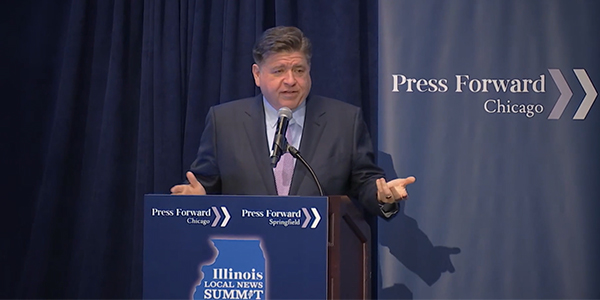
The Illinois Local News Summit is an annual event held in Chicago that focuses on supporting a strong, free press and addressing the challenges facing local journalism. This year it was held on Friday, April 10, 2026, at the Union League Club in Chicago. This year’s featured speaker was Governor JB Pritzker.
Introducing the governor was Daniel Ash, president of the Field Foundation, a 501(c)(3) nonprofit and a private foundation with more than $50 million in assets. The foundation directs significant funding toward community organizing, journalism, and media storytelling.
Before introducing the governor, Mr. Ash offered glowing praise, declaring that his organization was “very, very pleased” to support local journalism initiatives and calling Governor Pritzker “awesome” for championing the Constitution and the First Amendment.
Not exactly a neutral introduction.
Governor Pritzker then delivered a passionate defense of local journalism, praising reporters as essential watchdogs who hold government accountable. On that point, he is absolutely right. A truly free and independent press is vital to a healthy republic.
But then comes the contradiction.
In his remarks, the governor highlighted his “Journalism Sustainability Tax Incentive Program,” which has funneled millions in taxpayer-backed support to media outlets. In 2025 alone, more than $4 million in tax credits were distributed to dozens of news organizations across the state. It’s hard to hold government accountable when they pay your salary.
This raises a fundamental question: When does a “free press” become a “purchased press”?
Can the media truly remain independent when it is financially supported by the very government it is supposed to scrutinize?
The strength of journalism lies in its independence. Reporters must be free to investigate, challenge, and confront those in power without fear or favor. But when government becomes a financial partner—even indirectly through tax incentives—it blurs the line between watchdog and beneficiary.
To be clear, the challenges facing local journalism are real. Consolidation, declining ad revenue, and the rise of digital platforms have hollowed out many newsrooms.
But the solution cannot be to tether journalism to government support. When it does, citizens will only receive the narrative that the government approves. And it’s already happening.
For years, there has been little or no coverage of conservative events.
When the government has a say-so of what’s reported, truth is trampled, leading to tightened control over other areas of everyday life. Sound far-fetched? It’s not. Consider the Chinese Communist Party.
The Chinese Communist government censors everything political. They curtail all political opposition and all events unfavorable to their communist regime. They monitor and surveil their people using the largest mass surveillance system in the world. People who criticize the government face severe consequences such as imprisonment and even torture. Their government-controlled media plays a critical role in this oppression.
Now, consider what’s happening here in Illinois.
This year, three Illinois House Democrats introduced the “Health Misinformation Act” (HB 4596)—legislation that would empower government agencies to police speech, deploy so-called “trusted messengers,” and potentially impose penalties on those accused of spreading “misinformation.”
There is little doubt that Pritzker’s “Journalism Sustainability Tax Incentive Program” will likewise require that so-called “misinformation” be rooted out in favor of government approved propaganda.
A New Era
We are living in an era of unprecedented access to information. Citizen journalism—through podcasts, video platforms, blogs, and even smartphones—has expanded the public square in ways unimaginable just a generation ago. The market is changing, and the media landscape is evolving.
That reality does not justify government intervention. It is not the role of the state to prop up an industry the market is actively reshaping.
Public trust in the media is already at historic lows. Recent Gallup polling shows that just 28 percent of Americans trust the media to report news fully, accurately, and fairly, while 72 percent express little to no confidence. Government-backed media funding will only deepen that skepticism.
In our day and age, news consumers aren’t unsophisticated. Most recognize when narratives are politically steered or constructed—subtly or otherwise. This is especially true of Generation Z.
A free press must not only be independent—it must be seen as independent, free from even the appearance of collusion or corruption.
This article was composed & finalized by the author.
IFA staff & AI tools were used for proofing & clarity.
Tags: Daniel Ash, Gov. JB Pritzker, Health Misinformation Act, Illinois Local News Summit, JB Prtizker, Journalism Sustainability Tax Incentive Program, Press Forward Chicago, Press Forward Springfield, Pritzker’s Pravda, Union League Club
 Uncategorized | David E. Smith |
  April 14, 2026 6:00 PM