Good News Regarding Bost’s Challenge to Illinois’ Late-Counted Ballots
Written by David E. Smith
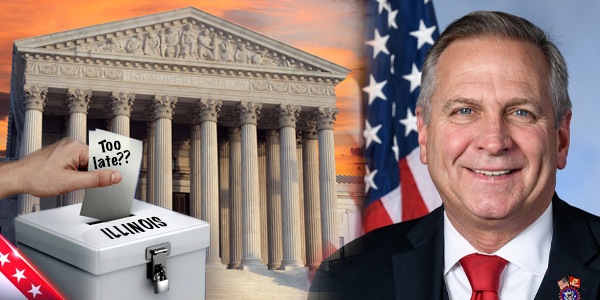
The U.S. Supreme Court delivered an important decision this week by ruling that Illinois Republican Congressman Mike Bost (R-Murphysboro) has legal standing to challenge Illinois’ controversial mail-in ballot law. The 7–2 decision in Bost v. Illinois State Board of Elections doesn’t decide whether the law itself is constitutional — but it opens the courthouse door for candidates to hold election rules accountable in court.
At issue is an Illinois statute that allows mail-in ballots postmarked by Election Day to be counted up to two weeks afterward. Previous lower court rulings dismissed Bost’s case on the ground that he lacked a concrete injury — largely because the late-arriving ballots didn’t change the outcome of his election. But the U.S. Supreme Court recognized that candidates do suffer a real interest in how votes are counted and how election laws are applied, regardless of whether the specific ballots swing an election.
Chief Justice John Roberts, writing for the majority, emphasized that election rules are not abstract matters and that candidates should not be barred from challenging procedures that affect the integrity, timing, and administration of federal elections. His opinion rejected lower courts’ stricter standing tests and affirmed that “candidates have standing to challenge the rules that govern the counting of votes in their elections.”
Although the Court didn’t yet swat down Illinois’ alarmingly liberal ballot-counting extension, it did revive Bost’s lawsuit and send it back to the lower courts to be judged on the law, not procedural excuses. That’s no small thing. The ruling makes it far harder for states to hide behind technicalities while they tinker with election rules, and it gives candidates across the country a real chance to challenge election manipulation well before voters ever go to the polls.
Justice Amy Coney Barrett, joined by Justice Elena Kagan, wrote a concurring opinion grounding the Court’s ruling in Bost’s claim of financial injury — the real and measurable costs of monitoring Illinois’ extended ballot counting — rather than relying solely on his status as a candidate.
Justices Ketanji Brown Jackson and Sonia Sotomayor dissented, warning that loosening standing requirements could flood courts with politically motivated lawsuits. But for many observers concerned about election accountability, this decision represents a significant check on state practices that extend ballot counting well past Election Day.
Carol Davis of Illinois Conservative Union has a optimistic response to this development, saying:
The SCOTUS decision in the Bost case regarding legal standing is a huge win for the rule of law. Now, the merits of the case – counting ballots after Election Day – must be resolved, and it might not be the Bost case alone upon which this is determined. Judicial Watch won a similar case in the 5th Federal Circuit court which stopped Mississippi from counting ballots for an additional 5 days after Election Day. That case has been elevated to the Supreme Court. Arguments will be made in April, and SCOTUS is expected to hand down a decision in July. Amazingly, we might possibly see an end to counting ballots after Election Day which will impact the entire nation, before the November General Election. Please pray!
We are encouraged by the U.S. Supreme Court’s decision to strengthen the legal footing of candidates like Congressman Mike Bost to enforce election laws. As his case now moves forward, we hope Illinois’ reckless policy of counting ballots for up to two weeks after Election Day will finally be struck down.
A helpful summary of Bost’s legal challenge was published this week by Legal Newsline:
Bost’s lawsuit specifically claims Illinois’ vote-by-mail regime clashes with a federal law that establishes an official Election Day for federal offices.
Under that federal law, votes must be cast by “the first Tuesday after the first Monday in November of every even-numbered year.”
However, Bost’s lawsuit asserts the Illinois rules improperly turn “Election Day” into an election period, without authorization from Congress.
Critics of the law have asserted the change in the law creates new opportunities for dominant parties and powerful campaign organizations to manipulate the system and cheat by counting questionable or illegitimate ballots.
The plaintiffs have asserted Illinois’ balloting system could allow potentially hundreds of thousands of otherwise invalid votes to sway close election contests.
Bost’s lawsuit further argues the law improperly “dilutes” the value of votes cast on or before Election Day, in keeping with federal law.
We now watch as this important case works its way through the courts — and quite possibly back to the U.S. Supreme Court on the merits. In the meantime, we must pray for honesty and integrity in our elections, that truth would prevail, and that fraud and abuse be exposed and rooted out.
Read more:
Labor, Voting Rights Groups Intervene in Illinois Voter Data Lawsuit
SCOTUS Says Illinois Congressman Can Sue Over State Mail-In Voter Laws

Tags: Amy Coney Barrett, Election integrity, Elena Kagan, John Roberts, Ketanji Brown Jackson, mail-in ballots, mail-in voting, Mike Bost, Sonia Sotomayor, U.S. Supreme Court
 Federal Issues, Voter Integrity | David E. Smith |
  January 15, 2026 10:00 AM