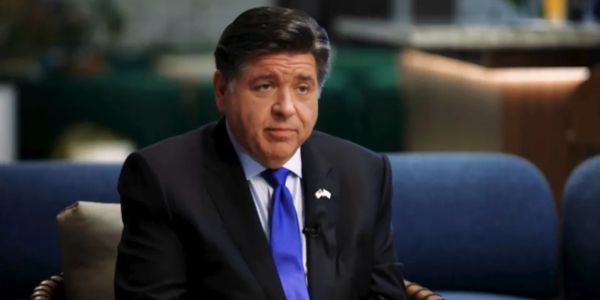
The Clean Face of a Dirty Business
Written by Thomas Hampson
John Adams’s test of character, the Pritzker story J.B. tells, and the history the polished biographies leave out
“Our Constitution was made only for a moral and religious People. It is wholly inadequate to the government of any other.” — John Adams, October 11, 1798 [1]
John Adams was not advocating a religious test for office. He was arguing that in self-government, our constitution—our laws—cannot replace character. In the same letter, Adams warned that avarice, ambition, revenge, and other passions, if unrestrained by morality and religion, could break even the strongest constitutional restraints.
Republican government therefore depends on people who can govern themselves before they are entrusted with governing others. [1]
That principle applies to citizens and with special force to public officials. We expect those who exercise governmental power to be honest, candid, self-restrained, and faithful to the public interest. We expect them not merely to comply with the narrow minimum the law requires, but to avoid arrangements that reasonably call their judgment, loyalties, or financial interests into question.
The people of Illinois have entrusted extraordinary power to Governor J.B. Pritzker, as they do with any governor. In Governor Pritzker’s case, he is also one of the wealthiest elected officials in the country. While wealth does not disqualify him or anyone else, the question is whether his character, judgment, associations, and transparency regarding that wealth are consistent with the standard of public trust that Adams believed self-government requires.
According to the story J.B. Pritzker tells about himself, the answer should be reassuring.
His public biography is a story of persecuted immigrants, hard work, family adversity, entrepreneurship, philanthropy, and public service. But it is a curated narrative. Important portions of the history of the fortune he inherited — including consequential relationships with organized-crime figures, mob-influenced financing, and offshore financial machinery – largely disappear from it.
I. The Story J.B. tells
Pritzker’s current campaign biography begins with service and achievement. He says he came to the governorship as an outsider with a successful background as a job creator, that he was fortunate to come from a family that served in the military and built successful businesses, and that after losing both parents at a young age, he wanted to follow their example of service. He describes himself as an entrepreneur and innovator, a supporter of early childhood development, a builder of the Illinois Holocaust Museum, and a champion of economic and social justice. [2]
His self-description as a job creator is misleading. His primary business career was in venture capital and private equity. He founded New World Ventures, later built the Pritzker Group with his brother Anthony, and invested inherited family capital in both startups and established companies. Contemporary reporting from the University of Chicago described the brothers’ division of labor as follows: Tony ran operations, while J.B. sought promising companies to invest in.
The thousands of jobs Pritzker now associates with his business career were therefore largely at companies financed, acquired, or supported by his investment organizations—not jobs created by businesses J.B. Pritzker personally founded and operated.
When reporters asked Pritzker’s 2018 gubernatorial campaign to document its job-creation claims, the campaign attributed more than 3,500 jobs to venture-capital investments, more than 500 to private-capital investments, and more than 7,000 to companies associated with the 1871 incubator he started. But the campaign did not provide reporters with a detailed accounting of which jobs at which employers were actually attributable to Pritzker.
Financing a successful entrepreneur can help create jobs. It is not the same as personally creating and operating the business that employs them.
Pritzker has repeatedly recounted that his great-grandfather Nicholas fled anti-Jewish pogroms in Ukraine as a child in 1881, arrived in America with almost nothing, slept in a Chicago train station, sold newspapers, learned English, and ultimately became a lawyer. He has described the family as owing its survival and later opportunities to America’s willingness to accept refugees. [3]
That history carries obvious emotional and political weight. It links one of America’s wealthiest families to refugees and persecution. It reframes the family fortune as an American success story: persecution, hard work, education, business success, philanthropy, social responsibility, and, finally, public service.
Pritzker also emphasizes personal adversity.
His father died when he was a young boy, and he later lost his mother. The point is not that he lacked privilege; he has publicly acknowledged extraordinary good fortune. Rather, his self-presentation does not cast him primarily as an heir managing inherited billions. It casts him as someone who inherited opportunity and chose to put it to constructive use.
Much of his account is true, but very selective.
The public story explains where the family came from, what it built, and what J.B. says he has done with his opportunities. It says nothing about how parts of the empire were financed, who the family’s most important lawyers and intermediaries were, which institutions supplied capital, or why the family made such extensive use of secretive trusts and offshore structures.
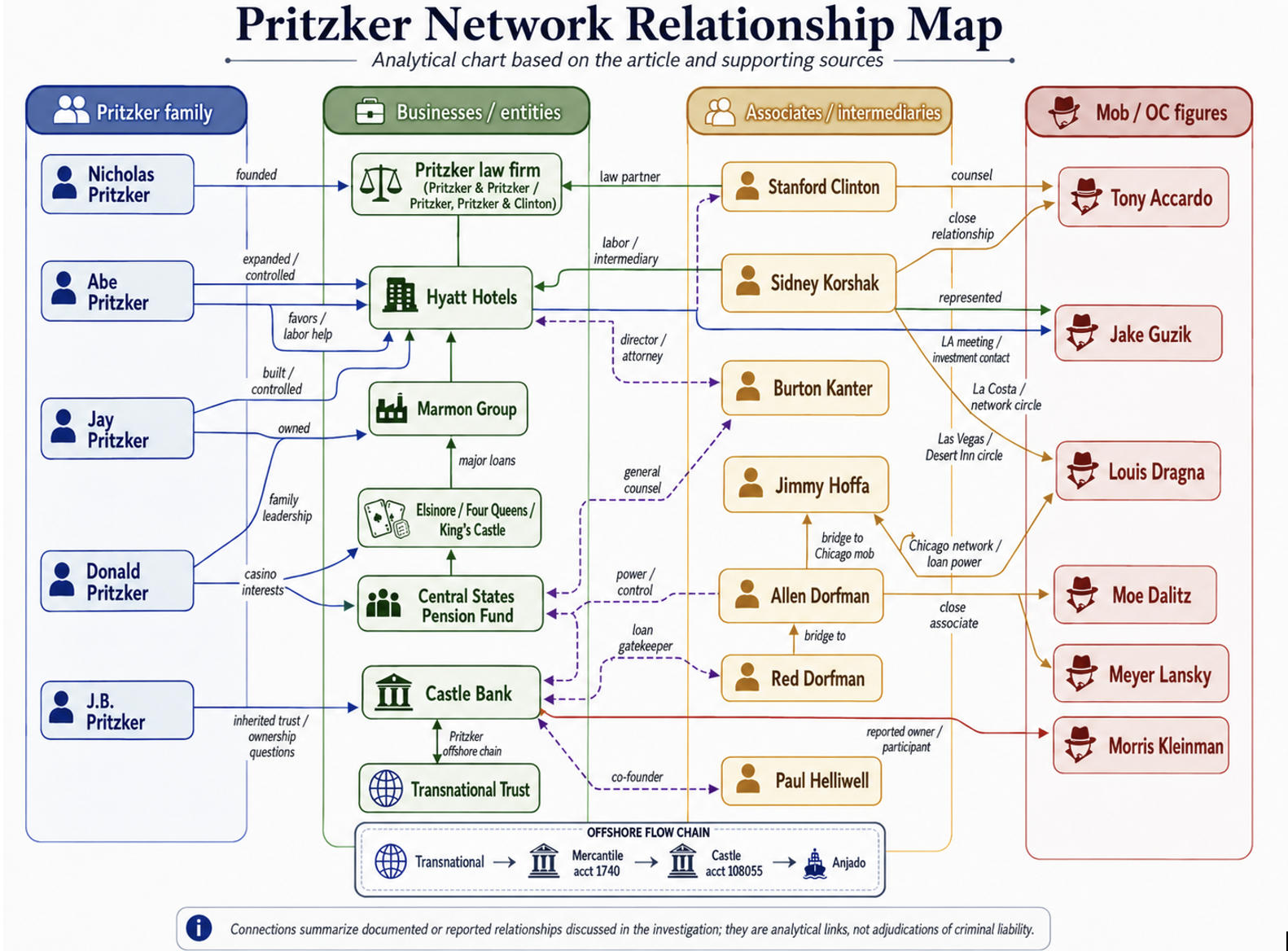
There is no Sidney Korshak in the campaign biography. No Stanford Clinton. No Jimmy Hoffa or Allen Dorfman. No Tony Accardo, Jake Guzik, Louis Dragna, Moe Dalitz, or Meyer Lansky. No Castle Bank. No explanation for why these names appear repeatedly in the historical record near Pritzker lawyers, Pritzker financing, Pritzker hotels, Pritzker casinos, and Pritzker offshore structures.
II. The same polished story appears in the documentary version
A recent Old Money Documentaries production, The Twisted History of the Pritzker Family: The Daughter Who Took Down Her Father, runs almost an hour. It is not a superficial profile. The film examines the rise of the family law firm Hyatt and Marmon, hundreds of family trusts, offshore jurisdictions, Burton Kanter, IRS litigation, the family breakup, and the court fight that forced part of the trust architecture into public view. [4]
Yet the transcript contains no mention of Castle Bank, Sidney Korshak, the Teamsters, Jimmy Hoffa, Allen Dorfman, Tony Accardo, Jake Guzik, Moe Dalitz, Louis Dragna, Meyer Lansky, organized crime, the Chicago Outfit, or the Mafia. [4]
That omission does not prove the filmmakers intentionally sanitized the history, but the effect is unmistakable. The Pritzker rise becomes a story of immigrant drive, extraordinary business acumen, sophisticated tax planning and family dysfunction. The mob-connected lawyers, Teamster financing, organized-crime figures and Castle Bank disappear.
Put those relationships back into the chronology, and the story becomes more about using mob influence to access money, labor power, political intermediaries, casino finance, and offshore secrecy, as the Pritzker empire expanded from Chicago into California, Nevada, and national prominence.
III. What it means to do business in a mob-controlled environment
Organized crime historically penetrated legitimate business because legitimate business provided what criminal enterprises needed: lawful income, respectable fronts, places to invest illicit proceeds, access to unions, political influence, and opportunities to convert coercive power into durable wealth.
The Justice Department describes eliminating organized-crime infiltration of legitimate organizations as a central purpose of the Racketeer Influenced and Corrupt Organizations Act (RICO). The FBI’s history of the Chicago Outfit likewise describes organized-crime crews insinuating themselves into unions and legitimate businesses and, in some cases, taking an interest in businesses to which they have loaned money or for which they have done favors, increasing their control and influence over time. [5]
A hidden mob interest need not appear on a stock certificate. The visible businessman can continue to run the company. Day-to-day management can remain professional and highly successful. The criminal value may lie elsewhere: capital, labor peace, access, protection, a financing channel, a silent economic interest, or the ability to call on the business when needed.
I have seen this in investigations I’ve conducted into the mob, as well as in intelligence I’ve gathered from my informants about the groups.
Association should not be used as a substitute for proof. A single social encounter proves little. But a trusted lawyer, a law partner, a lender, a pension-fund intermediary, a board member, a repeated financing source, a casino counterparty, or a shared offshore bank is different. Those relationships involve choice, reliance, money, and continuing access.
The same distinction applies to the word “partner.” The evidence does not establish that every named mob figure held equity in a Pritzker company. Some relationships were legal, some financial, some intermediary, some alleged, and some involved a common institution.
Finally, organized crime treats a profitable position as an asset. It does not typically surrender an economically valuable foothold merely because the visible business has become respectable.
Interests can end: they can be bought out, inherited, transferred, dissolved, lost in bankruptcy, or forced out by prosecutors and regulators. But termination is an event that typically leaves a record. While we cannot presume current mob ownership, we likewise cannot presume its disappearance without tracing what happened.
IV. The Pritzker law firm was not operating at a safe distance from the underworld
The Pritzker fortune did not begin with Hyatt. It began with a Chicago law firm. Nicholas Pritzker founded Pritzker & Pritzker in 1902. The firm later included Stanford Clinton and became an instrument for the family’s legal, business, and financial affairs. Gus Russo’s Supermob places Pritzker, Pritzker & Clinton at 134 North LaSalle Street within a broader Chicago network where law, politics, legitimate business, and organized crime repeatedly overlapped. [6]
Russo reports that Clinton became general counsel to the Teamsters Central States Pension Fund and represented individuals associated with the Capone organization. Russo also reports that the Pritzker firm represented Jake Guzik, a major Capone-era Outfit figure, and that the FBI recorded a friendship between Sidney Korshak and the Pritzkers. [6]
Korshak is central because he demonstrates how the ‘clean face’ system worked. He was not primarily valuable as a courtroom lawyer. Russo describes his power as a broker: he could reach corporate executives, union leaders, politicians, and Outfit figures, and corporate clients paid for the ability to secure labor peace or other outcomes through a few calls and private meetings. The product was influence, backed by relationships that respectable companies could not openly replicate. [6]
Abe Pritzker acknowledged that he liked Korshak and that Korshak had done him favors, while denying that he used him because of Korshak’s reputation. Russo records contrary accounts, including an attorney’s recollection that Abe described Korshak as the family’s lawyer, Korshak’s later SEC acknowledgment of work for the Pritzkers, and Melville Marx’s statement to the SEC that he believed Korshak was their labor lawyer. [6]
Russo also presents an earlier allegation involving Frontier Finance, which private investigator Jack Clarke described as a Pritzker holding company through which mob figures operated. Russo also identifies Frontier Finance’s president as Frank Buccieri, the brother of Outfit gambling figure Fiore ‘Fifi’ Buccieri. [6]
V. The names matter: these were not merely colorful businessmen
Tony Accardo: the power behind the Chicago Outfit
Stanford Clinton’s simultaneous relationships with the Pritzkers and Tony Accardo warrant more explanation than the label ‘mob boss’ alone. Accardo rose from the Capone era to become the Chicago Outfit’s dominant authority for decades. The FBI maintains a substantial investigative file on him; the Chicago Crime Commission describes him as the Outfit’s day-to-day boss beginning in the late 1940s and later as its ultimate authority. [7]
Accardo was never convicted of anything, much less of murder. But avoiding a conviction is not the same as having an innocent historical reputation.
Law-enforcement investigators and later organized-crime histories attributed multiple killings and murder orders to the Outfit under Accardo’s authority, including a series of brutal retaliatory killings following burglars’ entry into his home. I can’t prove every allegation, but it is important to understand how powerful and evil the men Clinton represented were, some of whom the Pritzkers relied on for financial backing. [7]
The significance of the Pritzker story is relational, not a case of magical guilt-by-association. Current evidence does not show that Accardo held Pritzker stock. It does show that a Pritzker law partner also served as counsel to the head of a criminal organization whose business methods included extortion, labor racketeering, illegal gambling, and murder. When that same lawyer then introduced a Pritzker to the people controlling a giant pool of Teamsters pension money, the relationship became economically consequential.
The record makes it clear to me that Accardo helped the Pritzkers’ businesses thrive.
Jake Guzik: Capone’s financial and political operator
Jake ‘Greasy Thumb’ Guzik was another figure closely tied to the Pritzker law practice. The FBI’s history of Al Capone identifies Guzik as one of the major mob figures targeted by federal tax investigations, along with Capone and Frank Nitti. Russo describes Guzik as a principal liaison between Korshak and Outfit leadership and reports that the Pritzker firm represented him. [8]
Again, the point is not that lawyers become criminals by representing them. Criminal defendants are entitled to counsel. The point is the larger pattern: the firm that became the financial nerve center of the Pritzker family was closely connected to the people who ran Chicago’s underworld. Those relationships later overlapped with business, labor, and financing channels important to the family’s expansion.
Louis Dragna: a made Mafia figure at an investment meeting with Abe Pritzker
The California evidence is more concrete. Russo quotes LAPD intelligence describing Abe Pritzker as closely connected to Capone Syndicate figures and as believing that Pritzker might be acting as a front for eastern hoodlum money being invested in Los Angeles. [9]
According to LAPD material cited by Russo, Abe Pritzker was observed in Los Angeles attorney Louis Hiller’s office discussing investment funds at a meeting that included Louis Tom Dragna. Contemporary Mafia reference material identified Dragna as a Mafia member involved in Southern California’s leadership structure and associated the Dragna organization with a broad range of organized crime activities. [9]
This was not merely Pritzker being photographed in the same room as an unsavory stranger. The reported subject of the meeting was investment funds.
Moe Dalitz: from organized crime to respectable casino power
Moe Dalitz is important because he embodies the transformation organized crime sought: illicit or coercive power converted into apparently respectable ownership. Russo describes Dalitz as associated with Detroit’s Purple Gang before the Mayfield Road Gang and later as a major casino and business figure. Russo also notes that a California crime-control report listed Dalitz among the state’s top organized-crime figures. [10]
Dalitz’s name then appears in connection with Pritzker casino financing. Russo reports that Donald Pritzker met with Dalitz regarding the Four Queens loan. Castle Bank is another point of intersection: Russo links Dalitz’s casino profits to Castle and says that Abe Pritzker and Stanford Clinton used the same offshore institution. [10]
Meyer Lansky: the financial architect of hidden interests
Meyer Lansky belongs in this story because he helps explain how a national organized-crime network could convert criminal capital, influence, and access into interests in seemingly legitimate businesses. He was not the overall boss of the Mafia or of every participating crime family; the Italian families and other factions retained their own leadership. Lansky’s exceptional value was cross-family.
Denton and Morris portray him as a trusted financial adviser, broker, accountant, allocator, and administrator who could assemble capital, structure joint ventures, track percentages, distribute proceeds, and bridge the criminal and legitimate business worlds. Functionally, he operated less like a national don than as a financial consigliere for multiple autonomous criminal interests. [22]
That role made Lansky particularly important for concealing ownership.
The Money and the Power reports that he received profits from more than half a dozen Las Vegas casinos without ever being licensed or publicly acknowledged as their owner or operator. The authors describe hidden pieces, shared interests, fronts, and off-book distributions, and say that insiders came to use the phrase ‘Lansky operation’ to refer to a method that could continue even when Lansky himself was not personally involved: organized crime operating through the legal surface world of finance, corporations, political influence, and respectable managers. [22]
Korshak ties that method directly to the network surrounding the Pritzkers. Russo reports that Korshak owned stock in Parvin-Dohrmann, whose Albert Parvin had been accused of acting as a front for Lansky and had employed Edward Levinson, identified in the source as Lansky’s Las Vegas bagman. Russo also reports that LAPD intelligence placed Korshak at a 1968 La Costa meeting with Moe Dalitz, Allen Dorfman, Lansky-associated Wallace Groves, and Mrs. Jimmy Hoffa to discuss the proposed sale of the Stardust to Parvin-Dohrmann. According to Russo, law enforcement believed Lansky had directed Dalitz to sell; Korshak took credit for arranging the transaction. [23]
Dalitz provides another link. He operated within Lansky’s Las Vegas and Caribbean gambling sphere and later appeared in connection with Pritzker’s casino financing. Russo also links Dalitz’s casino profits to Castle Bank, the same offshore institution he says was used by Abe Pritzker and Stanford Clinton. [10][23] Lansky was therefore not a stray name on the periphery of the story. The network surrounding the Pritzkers intersected with his world through Korshak, Dalitz, Dorfman, Hoffa, Las Vegas casino finance, and offshore institutions.
This does not establish that Lansky personally owned a Pritzker interest.
The people who provided or facilitated financing, labor leverage, and business access for the Pritzkers operated within a system in which beneficial ownership could be deliberately separated from record ownership. In that setting, the absence of a gangster’s name from a Pritzker stock ledger is less conclusive than it would be in an ordinary financing history.
Jimmy Hoffa and Allen Dorfman: workers’ pension money as business capital
Hoffa and Dorfman were important because their power was financial. They controlled a pension fund built from the earnings of ordinary truck drivers, warehouse workers, and other union members. Russo describes the Central States Pension Fund as a huge pool of relatively inexpensive capital, with its lending power concentrated among officials and advisers with deep underworld connections. [11]
Brill’s 1978 investigation explains why the lender’s character matters. He describes Hoffa as deliberately turning Central States into its own bank, lending directly rather than simply placing its money with conventional financial institutions. Brill reports that Hoffa viewed those loans as a source of leverage and that hotels, resorts, and other real estate projects were especially attractive targets. After reviewing Fund records and analyses by the FBI, IRS, and the Labor Department, Brill concluded that, under Dorfman, the Fund operated as a special bank in which access to loans was commonly tied to kickbacks, personal connections, or organized-crime relationships. [11]
Hoffa was later imprisoned following federal convictions for jury tampering and fraud. After his release, he disappeared in 1975, and the FBI reports that he was murdered. Dorfman, who exercised enormous influence over pension-fund lending, was later convicted in a federal bribery conspiracy to influence a United States senator and was himself murdered. [11]
These details are significant because the mobbed-up Central States Pension Fund provided the Pritzkers with tens of millions of dollars in financing. Hoffa’s access to the Chicago Outfit ran through Red Dorfman, one of Accardo’s closest associates; Allen Dorfman later became the Fund’s de facto loan gatekeeper; and Stanford Clinton represented Accardo while serving as Abe Pritzker’s law partner and introducing Pritzker to Hoffa and Red Dorfman. Financing of this magnitude for Pritzker interests could not have occurred without Accardo’s approval. It depended on his approval. [11]
VI. The Teamsters lever: money that helped expansion
Russo reports that Stanford Clinton, Abe Pritzker’s law partner and an attorney for Accardo, introduced Pritzker to Jimmy Hoffa and Allen Dorfman. Russo further reports that Clinton received an interest in the Burlingame Hyatt in connection with his role. According to Russo, journalist Knut Royce located two letters from Abe Pritzker to Allen Dorfman seeking help in obtaining Teamsters financing. [11]
Russo reports that Pritzker enterprises received approximately $54.4 million in Teamsters Pension Fund loans between 1959 and 1975, including financing for casino-related projects. Alan Block independently reports major Pritzker financing from the fund and describes Hoffa and Dorfman working on Pritzker loans.
Steven Brill, writing from the Teamsters’ perspective in 1978, independently reported that $6 million went to Hyatt Hotel Corporation in 1959 and 1960, and that another $44 million was ultimately advanced to Hyatt, some through debenture purchases. Brill also noted that the Fund’s counsel at the time had formerly been a law partner of Hyatt’s chief executive. Brill does not identify that lawyer in the passage, so that identification remains separately sourced. [11][12]
The Nevada transactions make the benefit tangible. Russo reports that in 1972 the Pritzker-controlled Elsinore operation acquired the Four Queens and King’s Castle casino properties using Teamsters financing obtained on favorable terms, and that sources place Donald Pritzker in a meeting with Moe Dalitz regarding the Four Queens financing. That financing later drew direct federal scrutiny.
Brill reports that on February 1, 1978, the Labor Department sued the Fund’s post-ERISA trustees over fifteen allegedly imprudent loans — including a $30 million debenture issued by a Hyatt Corporation subsidiary for the Four Queens Hotel-Casino, which the government alleged was undersecured. The same complaint also named a $2.2 million loan to Alvin Malnik, Meyer Lansky’s associate. [10][11]
Jay Pritzker later denied that Korshak participated in Hyatt’s Nevada acquisitions or in negotiations with the Teamsters Pension Fund. However, according to Russo’s account of Korshak’s 1970 SEC testimony, Korshak acknowledged that Hyatt may have discussed a possible Nevada acquisition with him. [11]
VII. What did the network receive in return? The Marmon question
The record identifies concrete benefits flowing to Pritzker enterprises from people and institutions within this network: access to labor influence, large Teamsters loans, casino financing, introductions, and sophisticated legal and offshore expertise. The next question is consideration: what did the network receive in return?
Under the Lansky model, compensation need not appear solely as a legal fee or an ordinary interest payment. It could also take the form of a concealed minority interest, a continuing profit participation, an option, a side arrangement, or leverage carried through a nominee or intermediary. [22]
Marmon warrants particular scrutiny. The family documentary dates Jay and Robert Pritzker’s acquisition of the Colson Corporation to 1953 and reports that by 1964, dozens of manufacturing acquisitions had been consolidated into what became the Marmon Group. That expansion overlaps the period when Pritzker’s relationships with Korshak and Clinton were established and when Teamsters financing began flowing to Pritzker enterprises. [4][6][11] Marmon ultimately became one of the largest and most valuable components of the family business empire.
No document in our possession currently establishes an organized-crime interest in Marmon. But the question is reasonable and testable: did any organized-crime participant, Lansky-affiliated intermediary, or other member of this network ever acquire an undisclosed beneficial interest, profit participation, partnership, nominee, or other continuing economic interest in a Marmon predecessor, acquisition vehicle, subsidiary, or family holding structure? If not, what compensation or economic return did the network receive for the assistance and financing it provided to Pritzker interests more generally?
What was the source of capital for Colson and the subsequent Marmon acquisitions; who were the lenders, guarantors, brokers, labor intermediaries, and any side agreements, options, profit participations, and trusts; and what outside interests were consolidated into Marmon and later into family holding structures? If any Mob-related assistance was tied to those acquisitions but produced no continuing interest, the record should show what consideration was paid instead. If it did produce an interest, the next question is what became of it.
People and businesses can be known and judged accurately by the company they keep. A financier or lender does not merely affect reputation. Financing changes what a business can buy, how quickly it can expand, and which competitors it can outbid, or even which competitors are allowed to bid. Labor influence can affect construction, operating costs, and disruption. Access to casinos and politically sensitive jurisdictions can create opportunities. These are material business advantages.
VIII. Chicago money moves west
Law enforcement was examining Abe Pritzker’s ties to underworld-connected investment activity in Los Angeles just before the family’s California hotel expansion accelerated. In 1957, Jay Pritzker bought the first Hyatt property near Los Angeles International Airport and launched the chain that became the family’s most visible brand. [9]
The available evidence does not show that a particular dollar discussed at the Dragna meeting financed a specific Hyatt purchase. We cannot say that it did. But it is equally incomplete to tell the clean coffee-shop story of Hyatt’s birth without informing readers that law enforcement was simultaneously scrutinizing Abe Pritzker’s role in underworld-connected western investment.
The question for investigation is therefore transactional: what money was available, through whom, on what terms, for which properties, and with what continuing interests? That is the difference between historical atmosphere and a provable financial chain.
- Castle Bank: where the Pritzker business network met offshore secrecy
Castle Bank is where the Pritzker story shifts from relationships with questionable people to the financial machinery that could be used to conceal, transfer, and protect money from scrutiny.
Castle Bank & Trust was formed in Freeport, Bahamas, on October 8, 1964. Alan A. Block’s Masters of Paradise, drawing heavily on IRS investigative files, describes a deliberately opaque ownership structure. The original corporate records listed nominee shareholders, and Mercantile Bank and Trust held one of Castle’s five original shares. Block concludes that Chicago tax lawyer Burton W. Kanter was particularly instrumental in organizing the bank. Kanter later acknowledged that Castle had been organized at the instruction of one of his clients but invoked the attorney-client privilege rather than identify that client. Block reports speculation that the client was Cleveland racketeer Morris Kleinman. [12]
Castle did not become fully operational immediately. Block’s reconstruction indicates that it remained largely a shell company until 1967, when new officers and shareholders appeared and the bank moved into its own Nassau offices. Some of the supposed shareholders and officers were nominees; Block presents evidence that at least one was fictitious and another may have been long dead. Later filings with Bahamian banking authorities disclosed the people who would ultimately own Castle’s capital, even when their interests were concealed behind nominees or trusts. Those beneficial interests included Paul Helliwell and Burton Kanter, as well as other Castle officers and associates. A Panamanian entity called Fomentos held a major interest; Block reports that investigators believed it may have represented Kleinman’s interest in the bank. [12]
This was not merely another offshore bank. Block describes Castle primarily as a tax haven operated by lawyers with connections to organized crime, intelligence activities and wealthy American business circles. Its structures allowed American clients to hold assets through foreign trusts, numbered accounts and nominee arrangements that obscured beneficial ownership and made it difficult for the Internal Revenue Service to trace income. Castle could be used to hide otherwise legitimate profits, evade taxes, commit financial fraud or move illicit money. Most of its clients were not organized criminals, but some were.
The Castle records contained names from very different worlds. Operation Tradewinds material identified wealthy businessmen and entertainers alongside organized-crime figures. Russo reports that the depositor material included Moe Dalitz, Morris Kleinman, Sam Tucker, and other racketeers. The same records also listed members of the Pritzker family. According to Russo, journalist Knut Royce determined that the Pritzkers were Castle’s largest depositors.
That fact is more significant because one of the men behind Castle was not a stranger to the Pritzker organization. Burton Kanter was a Pritzker tax attorney and served on Hyatt’s board. Block places him among Castle’s owners, managers, and administrators. Thus, a lawyer who helped construct and operate the offshore bank was also a trusted professional adviser to the family that became its largest depositor.
The IRS eventually penetrated Castle’s secrecy enough to recognize what it was looking at. Evidence developed during Operation Tradewinds led the Service in 1973 to launch a special investigation, first called DECODE—Detection and Exposure of Concealed Overseas Deposits for Evasion—and later Project Haven. Investigators believed Castle was an American-controlled foreign corporation used to assist in tax evasion. They contemplated tax cases against depositors and conspiracy prosecutions against the Americans who owned and controlled the bank.
The investigation, however, became entangled in misconduct and institutional obstruction. IRS agents arranged for a Castle officer’s briefcase to be taken so its account records could be secretly photographed. Courts initially suppressed evidence from that operation because of the government’s unlawful conduct. The U.S. Supreme Court later ruled in United States v. Payner that a Castle depositor could not exclude the evidence merely because the government’s search had violated another person’s rights.
The damage to the investigation was nevertheless substantial. Block and Russo describe additional problems: IRS files were mistakenly turned over to Kanter and his lawyers; prosecutors failed to use independently obtained Castle records; senior officials resisted parts of the offshore investigation; and the CIA intervened because it had used Castle in covert operations. [12][13]
The collapse of the investigation, therefore, should not be confused with a finding that Castle’s owners or depositors had done nothing wrong. No court exonerated Castle Bank as a legitimate institution merely because portions of the government’s investigation were mishandled. What the surviving record establishes is that the IRS believed the bank was being used to conceal foreign assets and evade U.S. taxes, developed evidence sufficient to contemplate broad tax and conspiracy prosecutions, and then failed to bring many of those potential cases to judgment.
For the Pritzker family, the financial trail is unusually specific. Block traces Pritzker interests through Transnational Trust Company Limited; Mercantile Bank trust account 1740; Castle Bank account 108055; and, after Transnational changed its name, Anjado Limited. He reports that more than $28 million in capital gains from the liquidation of a company holding Pritzker hotel interests passed into that structure. [12]
The significance of Castle therefore extends beyond tax avoidance. Offshore trusts, nominees, coded accounts, and bank secrecy obscure beneficial ownership. The same machinery that can conceal how much one family owns can also hide who owns an interest alongside it. Given the Pritzkers’ documented historical relationships with people associated with organized crime, and the presence of both Pritzker interests and organized-crime figures within Castle’s financial network, the ownership question is not imaginary.
Did any of those relationships involve an undisclosed economic interest in Pritzker businesses? Do any such interests remain today?
- A national network, not a Chicago anecdote
Placed on a map, the relationships do not appear to be an isolated Chicago curiosity:
- Chicago – Pritzker, Pritzker & Clinton; Korshak; Guzik; Accardo; Teamsters intermediaries; family legal and financial structures.
- California – LAPD scrutiny of Abe Pritzker and Dragna-linked investment activity; the launch and expansion of Hyatt; Burlingame Hyatt interests.
- Nevada – Teamsters-backed casino finance; Four Queens and King’s Castle; Korshak, Dalitz and Lansky-connected casino structures; Hyatt acquisition questions.
- The Bahamas and Caribbean – Transnational Trust, Mercantile, Castle Bank, Anjado, coded transfers, nominees and bank secrecy.
- New Jersey – gaming regulators later examined Pritzker-Teamsters relationships in connection with the Playboy-Elsinore venture; Russo reports that the absence of key witnesses limited that line of inquiry. [14]
A pattern is not a conviction. But repeated relationships across jurisdictions, industries, and decades deserve more weight than an isolated social contact. People are, in part, legitimately known by the company they keep – especially when the same company appears in financing, legal representation, labor relations, casinos, and offshore banking.
XI. Once organized crime acquires a profitable foothold, what makes it leave?
No evidence presently establishes that J.B. Pritzker is knowingly associated with organized crime. No evidence presently establishes that an old Outfit interest might be included in one of his trusts today.
Those facts do not resolve the historical ownership question. If organized crime or an organized-crime-connected financier ever acquired an economic interest in a business or related structure, why assume the interest disappeared simply because the original individual died? The FBI’s own description of organized-crime infiltration explains why a piece of a legitimate business can become more valuable over time, not less. [5]
The Lansky model is important here because the disappearance or death of the intermediary does not necessarily terminate the underlying economic interest. If Lansky was administering a shared Syndicate interest, the beneficial claim could belong to other people or factions and could be assigned, inherited, exchanged, or transferred to another entity. The same analytical rule applies to any historical Pritzker relationship: trace the asset and the economic benefit, not merely the continued presence of the original name. [22]
A profitable hidden interest can be inherited, assigned to another person, placed in a trust, exchanged for another asset, transferred through a nominee, or bought out. It can also be eliminated by law enforcement, regulatory action, bankruptcy, or a negotiated exit. These are different hypotheses, and each should produce evidence somewhere.
That is why ‘once they are in, they do not simply get out’ should be understood as an investigative principle. Organized crime has an incentive to preserve profitable access. We do not prove continuation by pointing to an old connection. Instead, we test whether it continued by looking for an exit.
If an interest was bought out, where is the transaction recorded? If a trust was terminated, where are the termination and distribution records? If a beneficial interest was transferred, to whom? If a professional intermediary was replaced, who assumed the client relationship? If the answer is that there never was an outside interest, what evidence supports that conclusion?
The family breakup divided enormous pools of Pritzker wealth among heirs. It did not, so far as the public record shows, provide a public accounting of every outside beneficial interest that may or may not have existed within older structures. The legitimate question is not ‘prove the mob is still there.’ It is ‘show us what happened to the relationships and interests that the historical record gives us reason to trace.’
XII. J.B. inherited the fortune – and retained much of the opacity
J.B. Pritzker did not create the family relationships spanning the 1940s through the 1970s. Some predate his birth. His responsibility is different. Once he became an adult beneficiary, then a candidate, and finally governor, what did he do with the opacity he inherited?
He didn’t make those trusts transparent.
During the 2018 campaign, Paradise Papers reporting identified offshore companies linked to Pritzker, his brother Anthony, and close associates, created long after the death of the grandfather to whom Pritzker had attributed offshore trusts benefiting him. Pritzker said the entities were associated with trusts, were not personally created by him, had been disclosed, and served charitable interests. The International Consortium of Investigative Journalists (ICIJ) reported that he provided limited additional detail when pressed. [15]
After his election, Pritzker placed his personal investments into a blind trust managed by Northern Trust. His representatives have said that he does not direct investments or discuss investment decisions with the trustees. The Better Government Association, however, reported that the trust purchased stock in Centene, a major Illinois Medicaid contractor, after he became governor. His representatives said the purchase was made independently by the trustees and denied any breach of his pledge. [16]
That episode is not proof of corruption. It illustrates the structural problem. Formal separation from daily investment decisions does not necessarily provide the public with a complete picture of the economic interests surrounding a governor.
There can be legitimate privacy reasons not to publish every trust document, every beneficiary’s personal information, or every confidential business term. But those concerns do not explain why a governor cannot provide a much clearer accounting of material entities, major outside co-investors, trustees, managers, beneficial interests, and successor structures. He could disclose more than the legal minimum without making every family member’s finances a public record.
Given the family’s history, the most important transparency question is simple: are there any material outside interests in the structures from which J.B. Pritzker derives wealth that the public cannot identify? If there are none, an authoritative disclosure would help close the historical question. If there are, the public has a legitimate interest in knowing who those people or institutions are when evaluating conflicts of interest and loyalties.
XIII. J.B. Pritzker’s own conduct makes character a question independent of the old mob history
Even if the entire historical organized-crime issue were set aside, Pritzker’s record raises legitimate questions about taxes, transparency and judgment.
In 2018, the Cook County Inspector General concluded that the assessor’s office had been the victim of affidavits containing false representations related to the reassessment of a Pritzker Gold Coast mansion. Five toilets had been removed before an appraisal that treated the property as uninhabitable. The Inspector General calculated $331,432.03 in refunds and tax savings and characterized the episode as a scheme to defraud. Pritzker disputed wrongdoing and later repaid the amount. [17]
The Inspector General’s characterization was not a criminal conviction of J.B. Pritzker. But the episode is not merely partisan rhetoric. It is an official watchdog finding on a strategy that substantially reduced the property tax burden on a billionaire family.
As governor, Pritzker signed the 2019 Rebuild Illinois law, which doubled the base state motor-fuel tax from 19 cents to 38 cents per gallon and indexed future increases to inflation. The same legislation raised the ordinary passenger-vehicle registration fee from $98 to $148 and the standard vehicle-title fee from $95 to $150. Separate 2019 legislation imposed a statewide parking tax of 6 percent on hourly, daily, and weekly parking and 9 percent on monthly and annual parking. It also increased the state cigarette tax by $1 per pack. [18]
Consider the impact of those taxes. An income-tax increase falls on people based on taxable income and liability. Taxes and fees embedded in fuel, transportation, parking, and other ordinary transactions operate differently. Fuel taxes become part of the cost of driving and transporting goods. Taxes imposed on intermediate goods and business activity can be reflected in consumer prices, wages, investment returns, or some combination of the three. The Congressional Budget Office likewise distinguishes who formally remits a tax from who ultimately bears its economic burden, and attributes excise taxes on intermediate goods to households through consumption. [20]
Measured by that broader burden – not merely by a single income-tax rate – a strong case can be made that Pritzker’s cumulative tax-and-fee increases have exceeded those imposed by other Illinois governors over the past half-century.
A 2026 Illinois Policy Institute (IPI) accounting identifies at least 57 separate state tax and fee increases during the Pritzker administration, estimates their cumulative additional burden at more than $77 billion, and calculates that the median Illinois household pays nearly $1,400 more per year in state taxes than it would have under the tax levels Pritzker inherited. The IPI is an advocacy organization, and its methodology should be judged by the underlying enactments and calculations; however, the scale of the enacted increases is substantial, and the principal tax and fee changes are matters of public record. [21]
The more revealing issue is the contrast.
While using public office to approve taxes and fees that increase the compulsory cost of ordinary economic life, Pritzker has personally benefited from sophisticated financial arrangements designed to minimize or manage tax exposure, including the family’s offshore structures discussed above, and from the mansion reassessment, which produced more than $331,000 in tax savings before the Cook County Inspector General concluded that false representations had been used in the process.
Wealthy people are entitled to lawfully minimize their taxes. The question is whether a governor who repeatedly asks the public to provide more revenue applies the same philosophy to himself – and whether the public is given enough information about his offshore and trust structures to judge that question. [15][17]
The scale of his private finances appeared again in the Pritzkers’ 2024 tax disclosure. Approximately $1.425 million of roughly $10.66 million in adjusted gross income was gambling income, about thirteen percent of reported AGI. Pritzker described it as a net win from a Las Vegas trip and declined to disclose the amount wagered. That does not establish a gambling problem. It does show the extraordinary financial scale at which he can easily operate. [19]
Pritzker’s public position has consistently been that the Illinois government requires substantial revenue to meet its public obligations. His private financial history therefore raises a legitimate question: does he approach his own tax obligations with the same willingness to contribute that he asks of ordinary Illinoisans, or does he use every lawful advantage to minimize his own burden while keeping important parts of his wealth structure outside full public view?
The answer lies in consistency, judgment, and public trust, not merely in whether a particular tax strategy is legal.
None of these facts proves that J.B. Pritzker participates in organized crime. They do bear on a different question: how does a public official who presents himself as a champion of working families exercise judgment when his own wealth, tax strategies and private financial options are almost unimaginably distant from the citizens whose lives are affected by his decisions?
XIV. If the answer is innocent, greater transparency strengthens it
The strongest public question is not ‘Is J.B. Pritzker in bed with mobsters?’
The stronger question is why a public official whose family fortune grew amid this documented history continues to rely on structures that leave outsiders unable to identify all the material economic interests tied to that wealth.
If the historical relationships ended, explain how. If outside interests were bought out, transferred, or extinguished, identify the transaction for which disclosure is legally permissible. If every modern trust is purely a conventional family vehicle with ordinary professional advisers and no questionable outside interests, an independent accounting or trustee certification could state as much. If privacy law prevents disclosure of a particular fact, explain the legal restriction rather than treating ‘private’ as the end of the inquiry.
This is especially important because secrecy was not incidental to the older structures. Castle Bank, foreign trusts, coded transfers, and layered entities were valuable precisely because they separated the visible holder from the underlying financial reality. That does not prove illicit ownership today. It explains why opacity itself is a legitimate subject of public scrutiny.
The public is not entitled to invent an answer when evidence is missing. But neither should citizens be told that an information gap created by private financial structures proves there is nothing to see.
J.B. Pritzker has the power to dispel any speculation or concern. Why won’t he?
XV. Whose interests – and what would Adams expect?
The Pritzker family’s history contains much that appears genuinely admirable: survival, intelligence, entrepreneurship, industrial growth, architecture, philanthropy, and the creation of institutions of lasting value. But there is a much darker side to that history as well.
That darker record includes a family law firm operating within a network of Outfit-connected clients and intermediaries; a Pritzker law partner who also represented Tony Accardo and later served as counsel to the Teamsters Pension Fund; a Pritzker firm that represented Jake Guzik; an LAPD intelligence assessment on Abe Pritzker and eastern criminal money in Los Angeles; an investment meeting with Louis Dragna; tens of millions of dollars in Teamsters financing during the Hoffa-Dorfman era; casino transactions involving the same network; a reported meeting with Moe Dalitz; a network running through Korshak and Dalitz into Meyer Lansky’s casino-financial world, where hidden interests and fronts were a documented practice; and a trusted Pritzker tax lawyer and Hyatt director deeply involved with Castle Bank. [6][9][10][11][12][13][22][23]
These are just the relationships we know about and can prove. What don’t we know?
It also leaves an unanswered economic question that should not be lost amid the better-known Hyatt story: what, if anything, did the network receive beyond fees, loan repayment and ordinary compensation, and did any concealed economic interest ever attach to the industrial businesses that became Marmon? We do not presently have evidence that it did. But given the timing, the financing relationships and the hidden-interest methods documented elsewhere in the same network, the question warrants a transaction-by-transaction answer rather than an assumption. [4][11][22]
Those facts do not establish that J.B. Pritzker is currently engaged in criminal conduct. They do establish that his history of inherited wealth cannot responsibly be reduced to immigrant perseverance, brilliant dealmaking, and clever tax planning.
John Adams’s warning was fundamentally about the limits of law. A constitution cannot anticipate every temptation, eliminate every conflict, or force every powerful person to choose candor over secrecy. A free society therefore depends on character – on people willing to restrain themselves, disclose what ought to be disclosed, and put public obligations ahead of private advantage, even when the law might permit them to do less.
J.B. Pritzker asks Illinoisans to judge his character by the family story he tells: refugees who survived persecution, builders who seized American opportunity, philanthropists who gave back, and a descendant who turned privilege into service. If family history is relevant to that judgment, the whole history is relevant – including the company the family kept, the money it borrowed, the institutions it used, the secrecy it preserved, and the secrecy it still preserves today.
The same standard applies to how he handles money in office. A governor may lawfully advocate higher taxes and may lawfully arrange his private affairs to reduce taxes. But when those two practices occur together – broad tax and fee increases imposed on the public, aggressive tax minimization in his own affairs, and offshore structures whose full economic relationships remain difficult for citizens to see – the contrast becomes part of the character inquiry Adams placed at the center of self-government.
The question is not whether citizens can prove what Pritzker’s undisclosed structures contain. The question is why citizens should be required to guess when the governor and those who manage the structures can provide the answer.
John Adams believed that all of us, especially those in government service, should be honorable if our nation is to survive. Does J.B. Pritzker possess the character John Adams believed a republic requires?
Source notes:
[1] John Adams to the Massachusetts Militia, Oct. 11, 1798, Founders Online, National Archives. The quoted sentence appears in Adams’s warning that unrestrained passions could break constitutional restraints.
[2] JB for Governor, ‘Meet JB,’ current campaign biography, describing Pritzker as an outsider, job creator, entrepreneur and innovator and his family as military servants and successful business builders.
[3] J.B. Pritzker’s repeated public account of Nicholas Pritzker’s flight from pogroms and arrival in Chicago: Jewish Telegraphic Agency, Nov. 2018; Governor’s press/newsroom summaries of later interviews; and related public remarks.
[4] Old Money Documentaries, The Twisted History of the Pritzker Family: The Daughter Who Took Down Her Father, transcript supplied for review. The transcript discusses trusts, Burton Kanter, offshore jurisdictions, IRS disputes, Marmon’s development and family secrecy but contains no references to Castle Bank, Korshak, Teamsters, Hoffa, Dorfman, Accardo, Guzik, Dalitz, Dragna, Lansky, organized crime, mob or Mafia.
[5] U.S. Department of Justice, Justice Manual 9-110.000, Organized Crime and Racketeering; FBI historical materials on the Chicago Outfit and organized-crime infiltration of unions and legitimate businesses.
[6] Gus Russo, Supermob: How Sidney Korshak and His Criminal Associates Became America’s Hidden Power Brokers (2006), especially pp. 33-40 and 92-96, on Korshak, Pritzker, Pritzker & Clinton, Stanford Clinton, Jake Guzik, Frontier Finance and related FBI/SEC/Chicago Crime Commission material. Individual allegations should be checked against Russo’s underlying cited records before publication.
[7] FBI Records: The Vault, Anthony Accardo files; Chicago Crime Commission historical profile of Anthony Accardo; later investigative reporting concerning killings attributed to Accardo and the Outfit. The article deliberately states such murder claims as attributed, not adjudicated.
[8] FBI, ‘Al Capone,’ identifying Jake Guzik among major Capone-era mob figures targeted in federal tax investigations; compare Russo, Supermob, on Guzik’s liaison role and the Pritzker firm’s representation of him.
[9] Russo, Supermob, pp. 92-96 and related California material, quoting LAPD intelligence concerning Abe Pritzker, Louis Hiller and Louis Tom Dragna. The ‘front for eastern hoodlum money’ language is an investigative assessment, not a court finding. Contemporary Mafia reference material describes Dragna as part of Southern California Mafia leadership.
[10] Russo, Supermob, Las Vegas chapters and pp. 271-295, 564, describing Moe Dalitz’s organized-crime background, casino interests, Castle Bank connections and the reported Donald Pritzker-Dalitz contact concerning Four Queens financing.
[11] Gus Russo, Supermob, p. 219 and related Teamsters chapters, reporting Clinton’s role, the Royce letters, approximately $54.4 million in Pritzker Teamsters financing from 1959-1975, and the Hyatt/casino transactions. Compare Steven Brill, The Teamsters (1978), especially pp. 208-215, 250 and 258, on Hoffa’s use of Central States as a direct lending vehicle, Dorfman’s influence over loans, organized-crime and kickback connections, $6 million advanced to Hyatt in 1959-1960 followed by another $44 million, the Fund counsel’s prior law partnership with Hyatt’s chief executive, and the Labor Department’s 1978 allegation that a $30 million Hyatt-subsidiary debenture for the Four Queens was undersecured. FBI Detroit history describes Hoffa’s disappearance as a reported murder; DOJ records describe Allen Dorfman’s later federal bribery prosecution.
[12] Alan A. Block, Masters of Paradise: Organized Crime and the Internal Revenue Service in The Bahamas (1991/1998/2019), Chapter 7, especially pp. 191-204, on the Pritzkers, Burton Kanter, Hyatt, Teamsters financing, Transnational Trust, Mercantile account 1740, Castle account 108055 and Anjado Limited.
[13] Russo, Supermob, pp. 565-569, on Castle Bank, Paul Helliwell, Morris Kleinman, Burton Kanter, Stanford Clinton, coded/numbered offshore transfers, Operation Tradewinds and Castle depositor material; compare Block, Masters of Paradise.
[14] Russo, Supermob, pp. 615-616, on New Jersey Casino Control Commission scrutiny of Pritzker-Teamsters relationships and the absence of key witnesses.
[15] International Consortium of Investigative Journalists, ‘Paradise Papers helps reveal J.B. Pritzker’s offshore connections,’ Mar. 15, 2018, including Pritzker’s responses.
[16] Better Government Association / Illinois Answers Project, ‘Pritzker Trust Bought Stock in a Top Illinois Contractor After He Was Elected Governor,’ Feb. 25, 2022, including the governor’s position that trustees independently manage investments.
[17] Cook County Inspector General findings as reported by the Chicago Sun-Times, Oct. 2018: $331,432.03 in refunds and savings; ‘scheme to defraud’ and false-representation language attributed to the Inspector General; Pritzker’s response and repayment should accompany the allegation.
[18] Illinois Public Act 101-0032 (2019), increasing the base motor-fuel tax from 19 cents to 38 cents per gallon and indexing later increases; raising the standard passenger-vehicle registration fee from $98 to $148 and the standard vehicle-title fee from $95 to $150. Illinois Public Act 101-0031 (2019) created the statewide parking excise tax at 6 percent for hourly/daily/weekly parking and 9 percent for monthly/annual parking and increased the cigarette tax from 99 to 149 mills per cigarette, equivalent to a $1 increase on a 20-cigarette pack.
[19] Associated Press and Capitol News Illinois, Oct. 2025, reporting approximately $10.66 million in 2024 adjusted gross income and $1.425 million in gambling income; Pritzker described the amount as a net Las Vegas win.
[20] Congressional Budget Office, Effective Tax Rates and related tax-incidence methodology. CBO distinguishes statutory remittance from economic incidence and assumes that excise taxes on intermediate goods are borne by households through consumption; broader business-tax burdens can fall on consumers, workers, or owners depending on the tax and market.
[21] Illinois Policy Institute, “Pritzker’s 57 tax and fee hikes cost Illinoisans $77 billion,” Apr. 28, 2026. The Institute counts at least 57 state tax and fee increases under Pritzker, estimates more than $77 billion in cumulative additional burden, and estimates nearly $1,400 more per year in state taxes for the median Illinois household compared with prior tax levels. It is an advocacy organization; the article uses the figures as a sourced comparative analysis rather than as an official state finding.
[22] Sally Denton and Roger Morris, The Money and the Power: The Making of Las Vegas and Its Hold on America (2001), especially pp. 23-29, on Meyer Lansky as a cross-faction financial broker and administrator, shared Syndicate profits, hidden casino interests, beneficial ownership without licensing, and the ‘Lansky operation’ as a recurring method. The book is used here as mechanism evidence; it does not itself establish a Pritzker-Lansky transaction.
[23] Gus Russo, Supermob, Las Vegas and Parvin-Dohrmann material, especially pp. 271-295 and 448-454, on Korshak, Parvin-Dohrmann, Lansky-associated interests, La Costa, the 1968 Stardust-sale meeting and front or silent-ownership allegations. Where consequential claims rest on law-enforcement intelligence or witness accounts, the underlying LAPD, FBI, SEC or other primary records should be obtained and cited when available.
Tags: Abe Pritzker, Al Capone, Allen Dorfman, Anjado Limited, Anthony Pritzker, Better Government Association, Burton Kanter, Castle Bank, Centene, Chicago Outfit, Donald Pritzker, FBI, Fomentos, Illinois Policy Institute, J. B. Pritzker, Jake Guzik, Jay Pritzker, Jimmy Hoffa, John Adams, Louis Dragna, Mafia, Marmon Group, Melville Marx, Mercantile Bank, Meyer Lansky, mob, Moe Dalitz, Nicholas Pritzker, Operation Tradewinds, Paul Helliwell, Project Haven, RICO, Sidney Korshak, Stanford Clinton, Steven Brill, Teamsters, Tony Accardo, Transnational Trust Company Limited, United States v. Payner
 Crime Culture, IFA News, Illinois Politics, Political | Alyssa Sonnenburg |
  September 8, 2026 9:00 AM