U.S. Senator Paul Challenges Vaccine Recommendations for Infants
Written by David E. Smith
Dr. Susan Monarez, PhD—a microbiologist, public health official, and former director of the Centers for Disease Control and Prevention (CDC)—testified yesterday before the U.S. Senate Health, Education, Labor, and Pensions Committee. She alleged that she was fired for refusing to comply with directives from Health and Human Services (HHS) Secretary Robert F. Kennedy Jr., which she said would have compromised scientific integrity.
According to Monarez, she was pressured to approve changes to the childhood vaccination schedule, including the possible removal of the hepatitis B vaccine for newborns. In her testimony, Monarez defended the continued importance of vaccines—specifically citing both the hepatitis B vaccine and the COVID-19 shot.
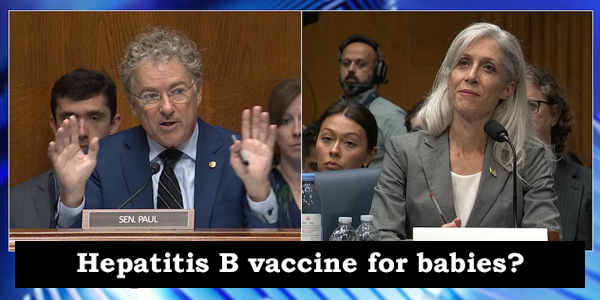
Early in the three-hour hearing, U.S. Senator Rand Paul (R-KY) went straight at Dr. Monarez, questioning the “so-called science” behind the CDC’s vaccine schedule for infants and children. Paul isn’t just a politician—he’s a practicing physician and licensed ophthalmologist with nearly 30 years of medical experience, who still volunteers to perform cataract surgeries several times a year.
He did not hold back, asking and answering his own question:
When we’re discussing the science here, we have to discuss what is the science in favor of giving the vaccine to a 6-month-old, and what are the benefits from that? And there is no benefit of hospitalization or death. And then what would the risks of that vaccine be? We have large population studies of the risks of the vaccine in younger people.”
We dare not overlook his point: the COVID-19 shot does not help keep people from hospitalization or from dying. “There is no benefit.“
Senator Paul pressed further, demanding that Dr. Monarez explain why infants are given a vaccine for a sexually transmitted disease:
What is the medical, scientific reason and proof for giving a newborn a Hepatitis-B vaccine if the mom is Hep-B negative?
Monarez sidestepped the question, prompting Paul to insist that “the burden should be on you” to prove that vaccines recommended for infants are truly beneficial.
Senator Paul’s exchange with Dr. Monarez may leave you convinced that her dismissal was justified.
Moreover, we must stop blindly bowing to “science” that is bought, bent, and manipulated to serve Big Pharma’s interests. Watch this six-minute clip and learn for yourself what they don’t want you to know:
Transcript:
Rand Paul: Dr. Monarez, I agree with you completely that we need to restore trust in public health. But in order to do so, we have to have a discussion about the actual science. And we can’t have a discussion of this as “But all vaccines are good. All vaccines are bad.” This is about specific vaccines. It’s about specific age groups. It’s about specific policies. Does the COVID vaccine prevent transmission?
Susan Monarez: The COVID vaccine can reduce viral load in individuals who are-
Rand Paul: Does it prevent transmission?
Susan Monarez: When you have reduced viral load, you will have reduced transmission.
Rand Paul: But in other words, it doesn’t prevent transmission. You can still transmit the virus if you’ve had the vaccine. In fact, there’s been reduced ability to interfere with transmission over time. And what we’ve found is the most recent one since Omicron is down around 16% reduction, if there is a reduction. Does the COVID vaccine reduce hospitalization for children under 18?
Susan Monarez: It can.
Rand Paul: It doesn’t. The statistics are inconclusive. And the reason you can’t prove that it does is there’s so few people under 18 that go to the hospital. The numbers are extraordinarily small. There’s, like, 76 million kids under 18 in our country. 183 died and a few thousand went to the hospital in 2020 and 2021. And since then, the numbers have dropped precipitously, and the idea and the issue needs to be discussed. But the COVID vaccine is not reducing hospitalization. It’s not statistically significant. Does the COVID vaccine reduce the rate of death for children under 18?
Susan Monarez: It can.
Rand Paul: Once again, “It can.” That’s a ridiculous answer. No, it doesn’t, and there is no statistical evidence that it does reduce the death rate. These are statistics. We’ve looked at it. When they approved it, they had this discussion at the vaccine committee that we’ve been talking about. During the discussion, they acknowledged that there was no proof of reduction in hospitalization or in death. So what they did is they said, “What can we use to try to make people take this vaccine?” They came up with this. They said that “If we give you a COVID vaccine, you make antibodies.” So, really, the whole recommendation for having a COVID vaccine from six months up is not based on hospitalization data, not based on deaths. It’s based on whether you make antibodies or not. And what people fail to see from this is I can inject you with a foreign protein every week and measure antibodies. You’ll make antibodies every time. It just means immunology work has nothing to do with whether you should get a vaccine every week.
So, when we’re discussing the science here, we have to discuss what is the science in favor of giving a vaccine to a six-month-old, and what are the benefits from that, and there is no benefit of hospitalization or death, and then what would the risks of the vaccine be. We have large population studies of the risks of the vaccine in younger people. And it turns out that you don’t see this as much if you look at the general population. But once you start isolating in by age group, which you have to do in COVID because there’s such a disparity among age group, you find that there is a risk of myocarditis, a significant event. It’s somewhere between 6 and 8 in 10,000, but that’s much greater than the risk of hospitalization or death, which are not even measurable because they’re so small.
So, you resisted firing people who have this idea that the COVID vaccine should be at six months. That’s what this is about. You didn’t resist firing the beautiful scientists that are career people and unobjective and unbiased. You wouldn’t fire the people who are saying that we have to vaccinate our kids at six months of age. That’s who you refuse to fire.
Susan Monarez: So, that assertion is not commensurate with the experience that I had with the individuals who are identified to be fired-
…
Rand Paul: Did any of the people you refused to fire believe that we should change the vaccine schedule and no longer force six-month-old kids to take it? Every one of them was adamant we should keep it at six months. Everybody’s alarmed we’re going to change the childhood routine. Well, we should. There is no medical reason. What is the medical reason to give a hepatitis B vaccine to a newborn whose mom has no hepatitis?
Susan Monarez: So, none of the discussion points that you just brought up were ever-
Rand Paul: That’s changing the childhood schedule. The child-
Bernie Sanders: Would you allow her to answer the question?
Chairman Bill Cassidy: Regular order. Regular order.
Rand Paul: Have your time. You have your time, Bernie. I got mine. Look, this is the debate over changing the childhood schedule. The hepatitis B vaccine on the schedule is given to newborns. What is the medical, scientific reason and proof for giving a newborn a hepatitis B vaccine if the mom is hep B negative?
Susan Monarez: I want to go back to the assertion associated-
Rand Paul: What is the medical reason for giving a hepatitis B vaccine to a newborn? See, everybody’s like blithely going along, “We can’t change the childhood.” You’re somehow terrible if you want to change the childhood. We should be discussing what is the childhood vaccine schedule. And you should be… The burden should be on you. You want to make all the kids take this? The burden is upon you and the people you wouldn’t fire to prove to us that we need to give our six-month-old a COVID vaccine, and that we need to give our one-day-old a hepatitis B vaccine. That’s what the debate ought to be about, not whether all vaccines are good or whether we live in Alice in the Wonderland.
Susan Monarez: I actually agree with you, and I was open to the science. I just would not pre-commit to approving all the ACIP recommendations without the science.
Rand Paul: Untrue.

Tags: Bernie Sanders, Big Medicine, Big Pharma, Bill Cassidy, CDC, COVID–19, Dr. Susan Monarez, Hepatitis-B vaccine, Rand Paul, Robert F. Kennedy Jr
 Uncategorized | David E. Smith |
  September 18, 2025 10:00 AM