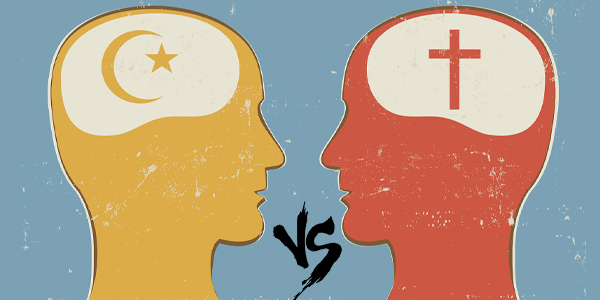
The Difference Between Christianity and Islam Was Just Given Center Stage
Written by Peter Heck
While the country has witnessed many funerals of national prominence, I think it’s fair to say that few have carried the kind of attention, emotion, and gravity as Charlie Kirk’s memorial service Sunday. And for those with eyes to see and ears to hear, it revealed a striking contrast between humanity’s two most influential faiths.
In the wake of losing her husband in the most brutal and public of ways, Erika Kirk stood before a grieving crowd and, as a Christian clinging to her faith, spoke words that sounded impossible:
On the cross, our Savior said: ‘Father, forgive them, for they know not what they do.’ That man. That young man. I forgive him. I forgive him because it’s what Christ did. And it’s what Charlie would do.
https://twitter.com/bennyjohnson/status/1969890384798261510
Forgiveness, in the face of assassination? Grace, extended toward the very one who shattered her world? That’s anything but natural. It was nothing less than the supernatural breaking through human frailty. And the impact didn’t stop in that room; it was the manifestation of Christlike mercy rippling outward to millions of online viewers around the world.
Meanwhile, that profound moment of supernatural grace stood in stark contrast to what had appeared just hours earlier on the national stage. Speaking on television, U.S. Representative Ilhan Omar mocked the very idea of honoring Kirk’s life, insisting his legacy ‘should be in the dustbin of history,’ and amplifying a video that labeled him a ‘Dr. Frankenstein’ whose monster turned on him and “shot him in the neck.”
Where Erika extended mercy, Omar doubled down on contempt.
Perfect spokeswomen, if you will, for their respective faith traditions.
The juxtaposition could not be clearer. Christianity, at its truest, runs against every human instinct. It announces a Savior who forgave His executioners and calls His people to do the same. Islam, as it was represented in this moment, responded not with forgiveness but with fury.
No one articulated this contrast more powerfully than someone who has lived on both sides of it. Sana Ebrahimi, an ex-Muslim from Iran, affirmed the reality of Islam demonstrated in the bitterness of Representative Omar:
In Islam, even though we believe that good people go to heaven, the relationship with God is taught through fear. Funerals are overwhelmingly sad, often filled with warnings of the terrifying first night in the grave. Growing up hearing that, and then witnessing people celebrate life, speak of God’s love, and remember someone through the impact he had on others; it felt so refreshing, so positive.
After watching Erika Kirk’s words, Ebrahimi was dumbfounded, offering this reflection:
I cannot fathom the strength it takes to stand and deliver such a meaningful speech after losing the love of your life. But even more than that, the grace it takes to forgive the very person who destroyed your world. I cannot imagine myself … inviting others to spread God’s love in response because, as she said, ‘we do not respond to hate with hate.’ That is powerful beyond words.
If this is what Christianity truly embodies, then I am envious of those who get to experience that feeling.
Yes, Ms. Ebrahimi, that is what Christianity represents. That is the difference on display. Where one worldview produces anger, the other produces forgiveness. Where one instills fear, the other offers hope. Where one clings to grievance, the other testifies to grace.
The world may debate Charlie Kirk’s politics or personality for years to come. But what no one can ignore is that his memorial service revealed something bigger than him. It put on full display the extraordinary difference between Christianity and Islam.
A difference measured not in arguments, but in love, joy, and forgiveness that the world cannot explain.
This article was originally published by NotTheBee.com.
Peter Heck is a writer, speaker, and teacher from Indiana. He is married to Jenny, and is the father of three kids. Peter holds to the infallibility and inerrancy of Scripture in his teaching and writing, and has a passion for biblical literacy and for demonstrating the Bible’s applicability to all of life.
Peter is the lead opinion writer for “Not the Bee.” His opinions have also been published in the Washington Times, Washington Post, USA Today, and on CNN, MSNBC, and Fox News. A former radio host, Peter produces a daily podcast and has authored a number of books on Christians and the culture.
 Faith & Religion, Islam & Sharia | David E. Smith |
  September 27, 2025 3:00 PM